
Master Market Volatility: Why You Need Uncorrelated Strategies
PineForge Team
Automated Trading Platform
You operate in a market defined by constant flux. A single strategy, no matter how optimized, is a single point of failure. It leaves your capital exposed. When market conditions shift, when volatility spikes, your meticulously built system can crumble, wiping out weeks or months of hard-won gains. This isn't a flaw in your strategy; it's a fundamental vulnerability in relying on one approach. You need more than a good strategy; you need a robust portfolio.
Your goal is not just profit, but resilient profit. This demands a portfolio of algorithmic trading strategies that do not move in lockstep. You need *uncorrelated strategies*. These are the bedrock of true portfolio diversification, designed to perform independently across different market cycles, assets, and conditions. They are your defense against the unpredictable, your path to a smoother equity curve, and your tool for consistent growth. PineForge empowers you to build, test, and deploy these essential components of a robust trading system.

The Peril of Correlation: Why Single Strategies Fail
You design a powerful strategy. You backtest it. It shows impressive returns. Then, the market shifts. What happens? Your single point of failure activates. Your strategy, perfectly tuned for one market regime, suddenly underperforms, or worse, incurs significant losses. This isn't a personal failing; it's a systemic risk.
When All Your Eggs Are in One Basket
Human traders often chase trends, creating correlated behavior. Machines, however, can be programmed for objective, diverse logic. When you rely on one strategy, you effectively put all your capital at the mercy of one specific market condition. If that condition reverses, your entire portfolio suffers. You need protection against this fragility. You need systems that act independently, reducing the impact of any single market shock.
Understanding Market Interdependence
Markets are interconnected. A major economic event can send ripples through forex vs crypto trading, affecting gold strategies, and even broader equity markets. Many strategies, despite appearing different, share underlying sensitivities. They might all be trend-following, or all mean-reverting. During periods of high volatility or crisis, these seemingly distinct strategies often become highly correlated, failing simultaneously. You must actively seek out strategies that respond differently to market inputs, ensuring true diversification across your trading activities.
What Defines Uncorrelated Strategies?
Uncorrelated strategies are not simply different strategies; they are strategies whose returns exhibit a low or negative statistical relationship. They don't move together. When one performs well, another might perform neutrally, or even poorly, but crucially, they don't *all* suffer simultaneously. This independence is what stabilizes your overall portfolio.
Beyond Simple Diversification
True uncorrelated strategies go beyond just trading different symbols. You might trade EURUSD with a trend-following trading bot and BTCUSD with a mean-reversion approach. Or, you might use a high-frequency strategy on one asset and a long-term swing strategy on another. The key is that the underlying *logic* and market sensitivities of each strategy are distinct. This ensures that a specific market condition that negatively impacts one strategy does not necessarily impact the others in the same way, or at all.
Metrics of Independence: Correlation Coefficient
You quantify strategy independence using the correlation coefficient. This metric ranges from -1.0 to +1.0:
Your objective is to combine strategies with low (close to 0.0) or negative correlation. PineForge's powerful backtest engine allows you to analyze and identify these relationships, giving you the data you need to make informed decisions about your portfolio composition.
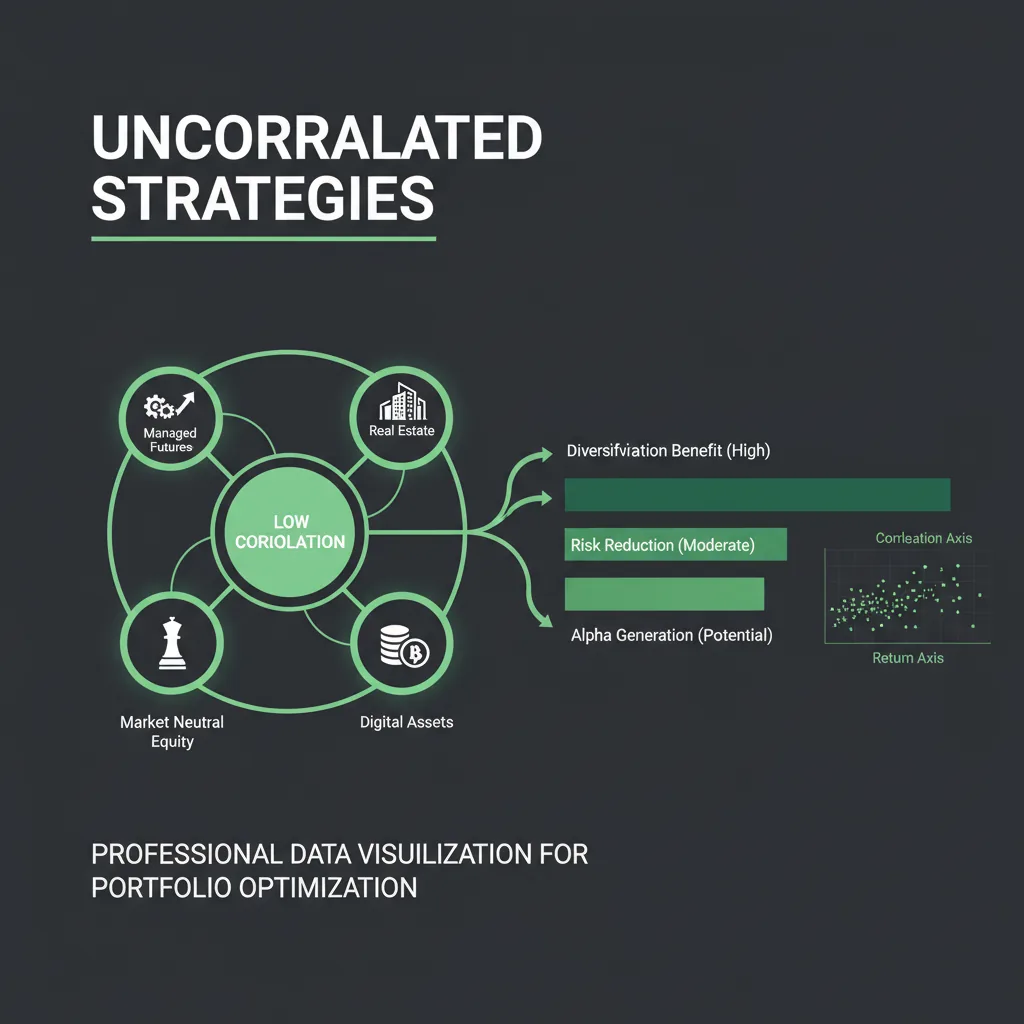
Building Robust Portfolios with Uncorrelated Strategies
You are the architect of your trading future. Building a portfolio of uncorrelated strategies is a deliberate act of engineering resilience. It shifts your focus from maximizing individual strategy returns to optimizing overall portfolio stability and growth.
Mitigating Systemic Risk
When you combine strategies that operate independently, you inherently spread your risk. If one strategy experiences a drawdown, others may be performing well, offsetting the loss. This significantly reduces your overall portfolio volatility and drawdowns, leading to a much smoother equity curve. Your capital remains protected, even during turbulent market phases. This is fundamental risk management.
Expanding Your Opportunity Set
Uncorrelated strategies allow you to capture profit opportunities across a wider range of market conditions and asset classes. You are not limited to a bull market for equities, or a specific trend in forex. You can deploy gold strategies alongside crypto strategies, or use short-term scalpers with long-term position traders. This broadens your reach, ensuring you have active strategies generating returns regardless of the prevailing market environment.
Practical Application: Combining Logic
Consider combining a fast-moving average crossover strategy with a mean-reversion strategy based on trading indicators like RSI. These two approaches often behave differently. The EMA crossover thrives in trending markets, while the RSI mean-reversion seeks reversals in range-bound conditions. Pairing them offers a more balanced approach. For example, an EURUSD trend strategy could deliver substantial returns, like the
| Correlation Coefficient | Interpretation |
|---|---|
| +1.0 | Perfect Positive Correlation |
| 0.7 to 0.9 | Strong Positive Correlation |
| 0.3 to 0.6 | Moderate Positive Correlation |
| 0.0 | No Linear Correlation |
| -0.3 to -0.6 | Moderate Negative Correlation |
| -0.7 to -0.9 | Strong Negative Correlation |
| -1.0 | Perfect Negative Correlation |
Start Trading Smarter
Build, backtest, and deploy your strategies with PineForge. No coding experience required.