Multi-Timeframe Strategies for Automated Trading Bots
PineForge Team
Automated Trading Platform
A trader watching a 15-minute chart sees a clean breakout setup, takes the trade, and gets stopped. The same trader checking the 4-hour chart afterwards realises the breakout was against the dominant trend — a counter-trend trade dressed up as a continuation. The bot equivalent of this mistake is more frequent and more expensive, because the bot doesn't have eyes on the higher chart.
Multi-timeframe (MTF) logic fixes the highest-leverage problem in single-timeframe strategies: signals that are technically valid but contextually wrong. This guide covers what MTF actually means, the three implementation patterns that work, the Pine Script syntax for v6, and the backtest evidence that MTF improves Sharpe by more than any reasonable amount of parameter tuning on the same strategy.
What is a multi-timeframe trading strategy?
A multi-timeframe strategy uses information from at least two timeframes to make trading decisions. The most common pattern: a higher timeframe (HTF) defines the trade direction, and a lower timeframe (LTF) defines the entry timing.
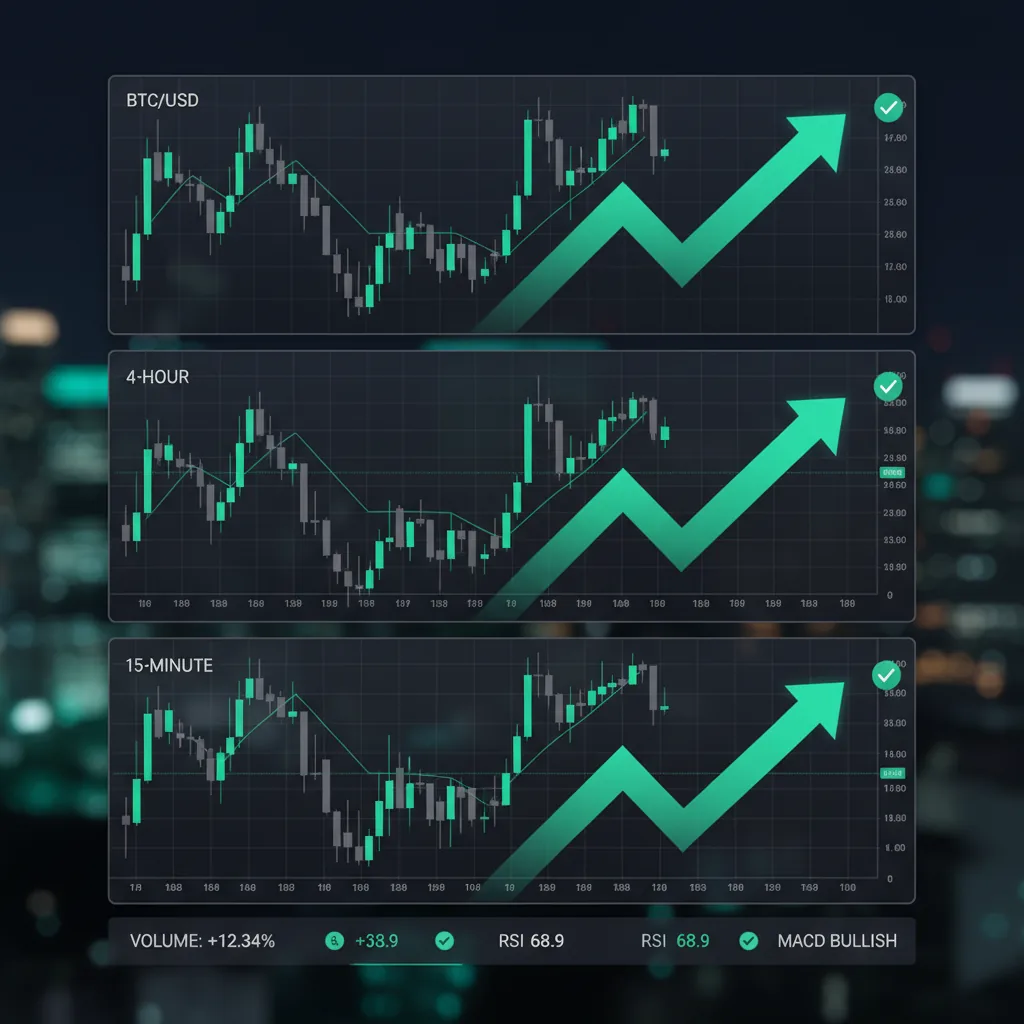
Concrete example: the 4-hour chart's 50 EMA is rising (HTF context says "trend is up"). The 15-minute chart pulls back to its 20 EMA and bounces (LTF entry trigger). The bot only takes long entries when the HTF condition is met, and uses the LTF for precise entry and stop placement.
This is fundamentally different from single-timeframe trading. A single-timeframe bot looks at one chart and acts. An MTF bot has a hierarchy: context first, signal second, both required.
Why MTF strategies outperform single-timeframe ones
The reason is statistical, not philosophical. Most retail strategies have small per-trade edges. Edge that small gets dominated by the largest source of bad trades: signals taken against the dominant trend.
A 2024 analysis from Quantpedia's strategy library compared single-timeframe and multi-timeframe variants of the same trend-following strategies across major FX pairs and gold. The MTF variants showed:
The pattern is consistent across instruments and timeframes. MTF doesn't make strategies more profitable per trade. It eliminates the worst trades.
The three MTF implementation patterns
Pattern 1: Higher-timeframe trend filter
The most common and the most useful. The HTF defines whether long, short, or both directions are allowed. The LTF generates entry signals; only signals aligned with the HTF context get taken.
//@version=6
strategy("HTF Filter", overlay=true)

htf_period = "240"  // 4 hours
htf_ema = request.security(syminfo.tickerid, htf_period, ta.ema(close, 50), lookahead=barmerge.lookahead_off)

trend_up = close > htf_ema
trend_down = close < htf_ema

// LTF entry: pullback bounce on 20 EMA
ltf_ema = ta.ema(close, 20)
long_signal = ta.crossover(close, ltf_ema) and trend_up
short_signal = ta.crossunder(close, ltf_ema) and trend_down

if long_signal
    strategy.entry("Long", strategy.long)
if short_signal
    strategy.entry("Short", strategy.short)
Simple, robust, easy to backtest. Works on almost any trend-following strategy.
Pattern 2: Multi-timeframe momentum alignment
Stricter — requires multiple timeframes to all agree before entry. Used by mean-reversion strategies that want to avoid trading against strong directional moves.
The implementation pulls RSI from three timeframes:
Long entries only when all three align. This filter is aggressive — many days will have no entry signals. The trades it does take tend to be high-conviction.
Pattern 3: Lower-timeframe execution precision
The opposite direction: HTF generates the signal, LTF refines the entry price. A daily moving-average crossover signals "go long" but the bot waits for the 5-minute chart to pull back to its 20 EMA before actually entering. This reduces entry slippage and tightens stops.
This pattern works best for swing strategies where the signal is rare but the entry timing materially affects risk-reward.
How do I write a multi-timeframe strategy in Pine Script v6?
The core tool is request.security(). In v6, the syntax is:
//@version=6
strategy("MTF Example", overlay=true)

// Pull 4H 200 EMA into the current (e.g., 15-min) chart
htf_ema_value = request.security(syminfo.tickerid, "240", ta.ema(close, 200), lookahead=barmerge.lookahead_off)

plot(htf_ema_value, "4H 200 EMA", color=color.orange)

// Trend rule
in_uptrend = close > htf_ema_value
in_downtrend = close < htf_ema_value
The critical parameter is lookahead=barmerge.lookahead_off. Without it, your backtest will use future data — the bot will know the 4H bar's closing price before it actually closed, producing impossibly good results that won't reproduce live.
If your MTF backtest looks too good, the first thing to check is the lookahead setting. The second thing to check is whether the HTF data is being requested *during* the HTF bar (live trading) or *after* it closed (backtest). The lookahead_off flag forces the request to use only confirmed (closed) HTF bars, matching live behaviour.
What's the difference between MTF and just looking at one bigger chart?
Direct answer: MTF lets you have HTF context AND LTF execution. Just using one bigger chart gives you context without execution precision.
A 4-hour-only strategy gets four trading opportunities per day at the bar close. A 15-minute strategy with 4-hour filter gets 96 opportunities per day, but only acts on the few that align with the 4-hour direction. The MTF version has more setup opportunities while maintaining the trend discipline of the higher timeframe.
The trade-off is complexity. Single-timeframe strategies are simpler to backtest and debug. MTF strategies introduce timing questions (which timeframe's close defines the signal? When does the HTF bar finalise?) that need explicit handling.
How many timeframes should I use?
Two is the sweet spot for most retail strategies. Three is workable. More than three is usually parameter optimisation dressed up as logic.
The rule of thumb: each timeframe should be 4–6x the previous one. Common pairings:
Avoid timeframe pairs that are too close (5-min + 15-min): they often move together and the filter adds little value. Avoid pairs that are too far apart (1-min + 1-day): the higher timeframe updates so rarely that the filter becomes nearly constant.
For multi-timeframe trend-following on gold, our gold strategies guide has specific timeframe recommendations validated on historical XAUUSD data.
MTF and the lookahead bias problem
The most subtle mistake in MTF strategies is data leakage. Pine Script v6's barmerge.lookahead_off setting prevents the obvious case, but more subtle cases exist:
The fix is consistency: backtest the same way the live bot will run. If the live bot acts at the HTF bar close, the backtest should reference close[1] from the HTF (the most recently closed bar). PineForge's backtest engine handles this automatically when the strategy is configured for confirmed-bar execution.
For a deeper dive into avoiding these bias issues, see our piece on walk-forward analysis.
Common MTF pitfalls
Three patterns we see most often when MTF strategies underperform their backtests:
lookahead=barmerge.lookahead_off.Conclusion
Multi-timeframe logic is the highest-leverage improvement most single-timeframe strategies can adopt. It doesn't require new indicators, machine learning, or more parameter tuning. It requires looking at one bigger chart before each trade and refusing to fight the higher timeframe.
The backtest evidence is consistent: MTF strategies trade less, lose less, and produce better risk-adjusted returns than the same logic on a single timeframe. The Pine Script v6 implementation is two lines of code plus a discipline of always disabling lookahead.
Build the higher-timeframe filter first. Add the lower-timeframe entry trigger second. Backtest it on PineForge with the full data range — and look at the drawdown reduction, not just the total return. The lower drawdown is where the value lives.
//@version=6
strategy("HTF Filter", overlay=true)
htf_period = "240" // 4 hours
htf_ema = request.security(syminfo.tickerid, htf_period, ta.ema(close, 50), lookahead=barmerge.lookahead_off)
trend_up = close > htf_ema
trend_down = close < htf_ema
// LTF entry: pullback bounce on 20 EMA
ltf_ema = ta.ema(close, 20)
long_signal = ta.crossover(close, ltf_ema) and trend_up
short_signal = ta.crossunder(close, ltf_ema) and trend_down
if long_signal
strategy.entry("Long", strategy.long)
if short_signal
strategy.entry("Short", strategy.short)//@version=6
strategy("MTF Example", overlay=true)
// Pull 4H 200 EMA into the current (e.g., 15-min) chart
htf_ema_value = request.security(syminfo.tickerid, "240", ta.ema(close, 200), lookahead=barmerge.lookahead_off)
plot(htf_ema_value, "4H 200 EMA", color=color.orange)
// Trend rule
in_uptrend = close > htf_ema_value
in_downtrend = close < htf_ema_valueStart Trading Smarter
Build, backtest, and deploy your strategies with PineForge. No coding experience required.