Best Pine Script Strategies for Automated Trading in 2026
PineForge Team
Automated Trading Platform
The Pine Script community has shipped thousands of strategies over the past decade. The vast majority don't survive walk-forward testing on real broker data with realistic execution costs. The handful that do hold up tend to share structural features — not specific indicators.
This guide ranks Pine Script strategy patterns by their actual durability across regimes, not their popularity on TradingView. The categories are organised by what they're good at and which market conditions they need to thrive.
Quick comparison: Pine Script strategy patterns in 2026
How These Were Ranked
The criteria were:
Strategies were excluded if they only worked on cherry-picked date ranges, required exotic parameter values, or showed unrealistic backtest metrics that didn't reproduce on out-of-sample data.
1. EMA Crossover with HTF Trend Filter
The most validated pattern in retail algo trading, and the foundation of PineForge's built-in Gold Trend Hunter V2 strategy. Two EMAs on the entry timeframe (typically 1H) plus a higher-timeframe trend filter (4H or daily) that gates trade direction.
//@version=6
strategy("EMA Cross + HTF Filter", overlay=true)

fast = ta.ema(close, 20)
slow = ta.ema(close, 50)
htf_ema = request.security(syminfo.tickerid, "240", ta.ema(close, 50), lookahead=barmerge.lookahead_off)

trend_up = close > htf_ema

if ta.crossover(fast, slow) and trend_up
    strategy.entry("Long", strategy.long)
if ta.crossunder(fast, slow) and not trend_up
    strategy.entry("Short", strategy.short)
Best for trending markets, gold and major FX pairs, beginner strategy builders.
2. Donchian Breakout + ATR Stop
Breakout strategy buying N-period highs and selling N-period lows with stop loss based on Average True Range. Originally popularised by the Turtle Traders; still effective on liquid instruments.
//@version=6
strategy("Donchian + ATR", overlay=true)

donch_high = ta.highest(high, 20)
donch_low = ta.lowest(low, 20)
atr = ta.atr(14)

if close > donch_high[1]
    strategy.entry("Long", strategy.long)
    strategy.exit("Stop", "Long", stop=close - atr * 2)
if close < donch_low[1]
    strategy.entry("Short", strategy.short)
    strategy.exit("Stop", "Short", stop=close + atr * 2)
Best for trending markets, breakout traders, any instrument with clear regime patterns.
3. RSI Mean Reversion with Trend Filter
RSI-based reversion with a filter to skip trades against the higher-timeframe trend. Pure RSI without a filter is one of the worst-performing strategies in retail; the filter is what makes it viable.
Best for ranging markets, slow-moving major pairs, traders who want non-correlated edge to add to trend strategies.
4. Bollinger Band Reversion
Buy near lower band, sell near upper band, with confirmation from RSI or session timing. Works in ranging volatility regimes; breaks down in trending markets.
See our detailed piece on Bollinger band trading strategies for the full implementation.
Best for range-bound markets, currency pairs in consolidation, equity indices during low-volatility periods.
5. Multi-Timeframe Trend Stack
Requires three timeframes (1H, 4H, 1D) to align directionally before entry. Strict filter, low trade frequency, high per-trade hit rate.
//@version=6
strategy("MTF Trend Stack", overlay=true)

rsi_1h = ta.rsi(close, 14)
rsi_4h = request.security(syminfo.tickerid, "240", ta.rsi(close, 14), lookahead=barmerge.lookahead_off)
rsi_1d = request.security(syminfo.tickerid, "D", ta.rsi(close, 14), lookahead=barmerge.lookahead_off)

all_bullish = rsi_1h > 50 and rsi_4h > 50 and rsi_1d > 50
all_bearish = rsi_1h < 50 and rsi_4h < 50 and rsi_1d < 50

if all_bullish and ta.crossover(close, ta.ema(close, 20))
    strategy.entry("Long", strategy.long)
Best for strong trending markets, swing strategies, traders prioritising win rate over frequency.
See our piece on multi-timeframe trading bots for the full framework.
6. Session-Based Breakouts
Identify the range of one trading session (e.g., Tokyo) and breakout from it in the next session (London). Works particularly well on yen pairs and during specific historical periods.
Best for session-aware traders, specific time windows, yen-cross trading. See our piece on Asian session range trading.
7. News-Aware Momentum
Strategy that explicitly blacks out around scheduled high-impact news events (FOMC, NFP, CPI). Same underlying logic as a regular momentum strategy, but with calendar filtering.
Best for any strategy improvement, especially on FX pairs and gold. See Fed day trading bot strategy.
8. Mean Reversion + Trend Filter (Hybrid)
Combines mean-reversion entry logic with a long-term trend filter that determines direction. The hybrid catches the directional bias of the trend while exploiting the short-term oscillation of reversion.
Best for mixed regimes, intermediate-skill traders, strategies designed to work in both trending and ranging conditions.
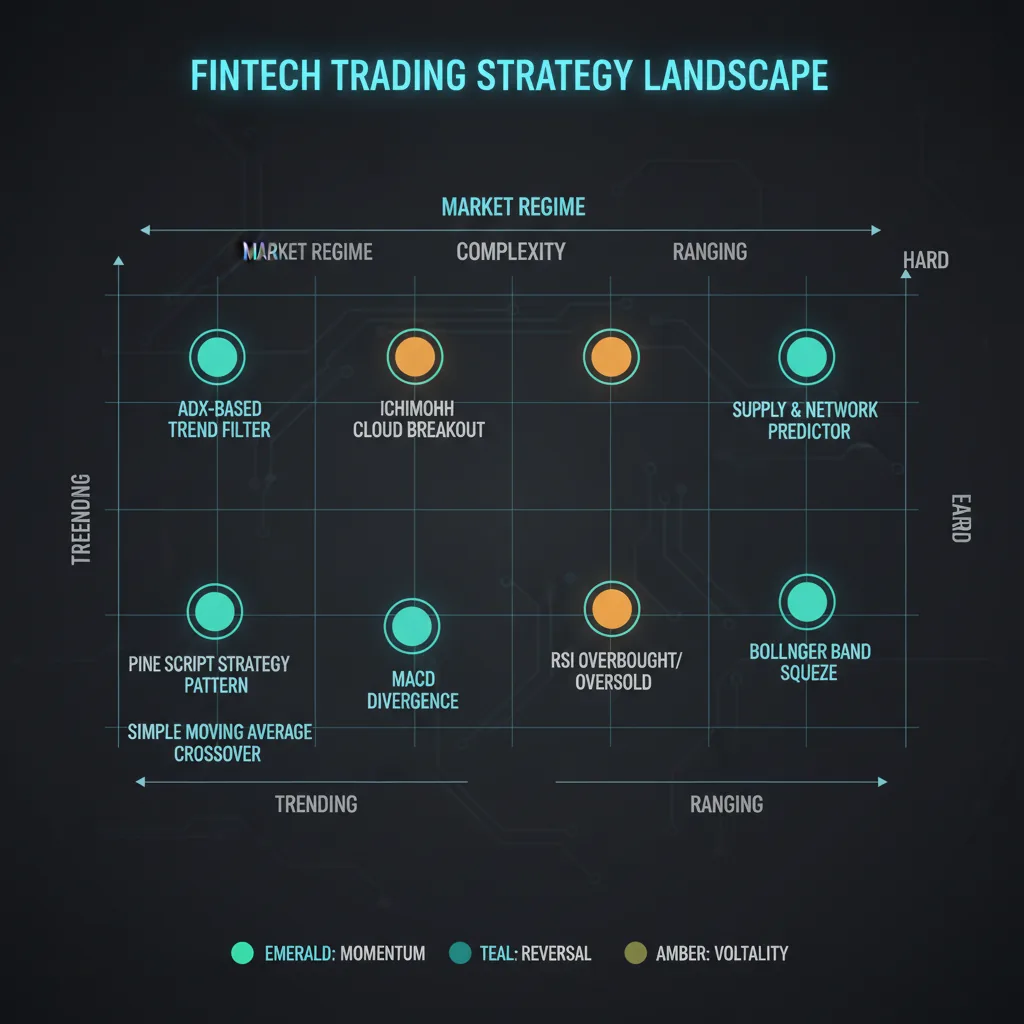
What Makes a Pine Script Strategy "Work" in 2026?
Three structural features show up in almost every long-term-durable strategy:
Strategies missing any of the three tend to be the ones that look great in backtests and disappoint in live trading.
What's the Easiest Pine Script Strategy for Beginners?
Direct answer: EMA crossover with HTF filter. Three reasons:
PineForge's Gold Trend Hunter V2 is a refined version of this strategy with empirically validated parameters for XAUUSD 1H. Use it as a starting point and modify from there.
How Do You Backtest a Pine Script Strategy Properly?
Three rules:
PineForge's backtest engine handles all three automatically when configured for the target broker.
Conclusion
The "best Pine Script strategy" depends on the market regime and the trader's goals. For trending markets on major instruments, EMA crossover with HTF filter or Donchian breakout are the most validated patterns. For ranging markets, filtered RSI or Bollinger reversion. For traders running multiple bots, mixing across patterns produces the best portfolio (see ensemble strategies).
The common features of durable strategies — HTF filter, ATR stops, news awareness — matter more than the specific entry logic. Build those in from the start and most reasonable strategy patterns will produce defensible live results.
Run your Pine Script strategy on PineForge to see exactly how it performs across years of real broker data — including the slippage and spread costs your live bot will actually face.
//@version=6
strategy("EMA Cross + HTF Filter", overlay=true)
fast = ta.ema(close, 20)
slow = ta.ema(close, 50)
htf_ema = request.security(syminfo.tickerid, "240", ta.ema(close, 50), lookahead=barmerge.lookahead_off)
trend_up = close > htf_ema
if ta.crossover(fast, slow) and trend_up
strategy.entry("Long", strategy.long)
if ta.crossunder(fast, slow) and not trend_up
strategy.entry("Short", strategy.short)//@version=6
strategy("Donchian + ATR", overlay=true)
donch_high = ta.highest(high, 20)
donch_low = ta.lowest(low, 20)
atr = ta.atr(14)
if close > donch_high[1]
strategy.entry("Long", strategy.long)
strategy.exit("Stop", "Long", stop=close - atr * 2)
if close < donch_low[1]
strategy.entry("Short", strategy.short)
strategy.exit("Stop", "Short", stop=close + atr * 2)//@version=6
strategy("MTF Trend Stack", overlay=true)
rsi_1h = ta.rsi(close, 14)
rsi_4h = request.security(syminfo.tickerid, "240", ta.rsi(close, 14), lookahead=barmerge.lookahead_off)
rsi_1d = request.security(syminfo.tickerid, "D", ta.rsi(close, 14), lookahead=barmerge.lookahead_off)
all_bullish = rsi_1h > 50 and rsi_4h > 50 and rsi_1d > 50
all_bearish = rsi_1h < 50 and rsi_4h < 50 and rsi_1d < 50
if all_bullish and ta.crossover(close, ta.ema(close, 20))
strategy.entry("Long", strategy.long)| Strategy Pattern | Best Market Regime | Typical Sharpe | Difficulty |
|---|---|---|---|
| EMA crossover with HTF filter | Trending | 0.8–1.2 | Easy |
| Donchian breakout + ATR stop | Trending | 0.9–1.4 | Easy |
| RSI mean reversion (filtered) | Ranging | 0.7–1.1 | Easy |
| Bollinger band reversion | Ranging | 0.6–1.0 | Easy |
| Multi-timeframe trend stacks | Strong trends | 1.0–1.5 | Medium |
| Session-based breakouts | Specific hours | 0.8–1.3 | Medium |
| News-aware momentum | High-impact events | Variable | Hard |
| Mean reversion + trend filter | Mixed regimes | 0.9–1.3 | Medium |
Start Trading Smarter
Build, backtest, and deploy your strategies with PineForge. No coding experience required.