Best Trading Bot Features for Indian Retail Traders in 2026
PineForge Team
Automated Trading Platform
Indian retail algorithmic trading operates in a different regulatory and tax environment than US, UK, or Asia-Pacific markets. SEBI regulations restrict direct offshore broker access, currency F&O instruments are the legal route for FX exposure, and 30%+ marginal tax rates on trading income change which strategies are actually profitable after tax.
This guide covers the features and configurations that matter for Indian retail traders running automated strategies in 2026 — including the regulatory framework, taxation considerations, and platforms that explicitly support INR settlement.
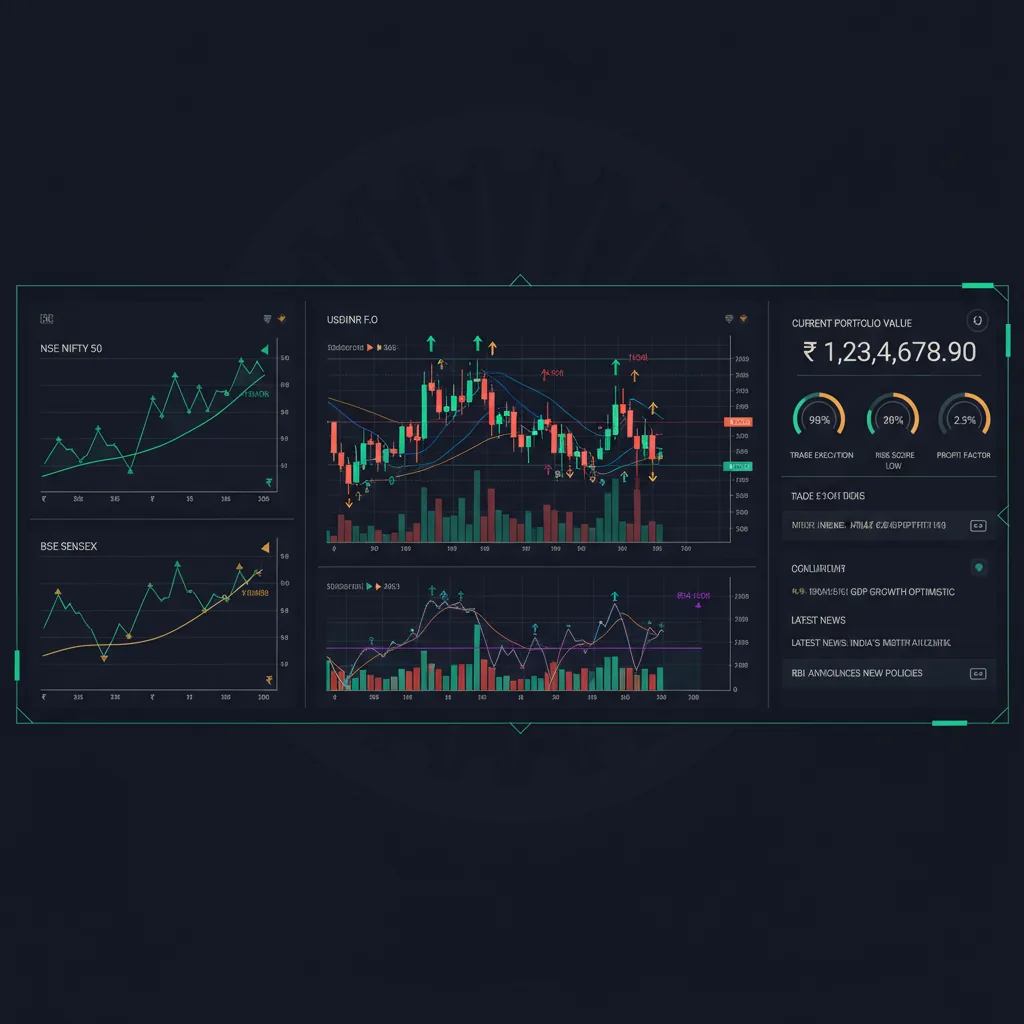
Quick comparison: trading bot features for Indian retail
Regulatory Framework for Indian Algo Traders
Two foundational rules shape what's possible:
SEBI restricts direct retail FX trading on offshore brokers. Indian residents can trade currency F&O on Indian exchanges (NSE, BSE) — pairs like USDINR, EURINR, GBPINR, JPYINR. Direct spot FX trading via offshore brokers operates in a regulatory gray area.
Offshore broker accounts must be reported. Indian residents holding accounts at non-Indian brokers must file Schedule FA annually under the Income Tax Act. Failure to report carries severe penalties — including up to ₹10 lakh per year of non-disclosure regardless of account size. See our trading bot tax reporting guide for the full framework.
For Indian retail traders, the legal tax-efficient route is currency F&O on Indian exchanges, with trades classified as non-speculative business income.
What Indian Traders Should Look For in a Bot Platform
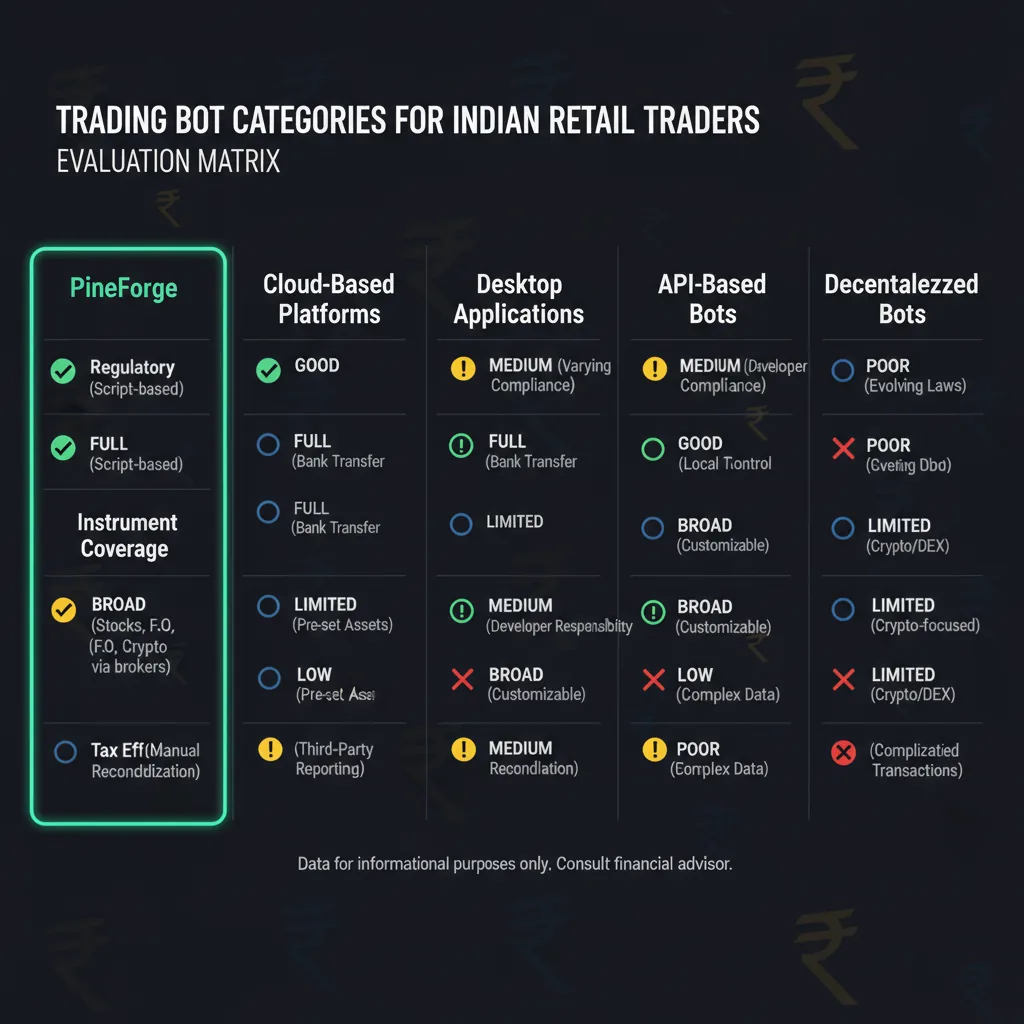
Six features that materially affect the Indian retail experience:
PineForge supports INR-denominated billing (via Stripe checkout in INR), Pine Script v6, and exports transaction history that maps to standard Indian tax categories.
1. Pine Script Platforms with INR Support
Pine Script automation platforms that accept INR payments and don't require offshore broker accounts are the strongest base for Indian retail algo trading. The strategy logic works on any instrument; the execution layer connects through whichever broker channel is legal for the Indian trader.
Best for Indian retail algo traders wanting to keep INR billing, avoid offshore broker complexity, and use modern strategy languages.
2. SEBI-Registered Domestic Algo Platforms
Indian-specific platforms registered with SEBI as algorithmic trading providers. Direct integration with NSE/BSE, native INR settlement, full compliance built in.
Best for Indian-instrument-only strategies (Nifty, BankNifty, USDINR F&O), traders prioritising regulatory clarity over global asset coverage.
3. Offshore Crypto Bots
Crypto trading bots operating from offshore exchanges. Indian users can technically access these but face the Schedule FA reporting requirement and the regulatory uncertainty around crypto in India.
Best for Indian traders explicitly accepting the offshore account reporting burden, generally not recommended given the regulatory direction.
4. MT5 Through India-Compatible Brokers
Some international brokers (Exness, IC Markets) operate with India-friendly onboarding. Allows MT5 automation while staying broadly compliant — though Schedule FA reporting may still apply.
Best for experienced Indian forex traders willing to manage offshore reporting, gold and forex automation specifically.
5. Domestic Stock Algo Trading
Indian brokers (Zerodha, Upstox) increasingly offer algorithmic trading APIs for NSE/BSE equity, F&O, and currency segments. Native INR settlement, no Schedule FA complexity.
Best for Indian equity and index F&O traders, users explicitly wanting full regulatory simplicity.
What Are the Best Instruments for Indian Algo Traders?
Direct answer:
Spot FX trading on offshore brokers operates in regulatory uncertainty. Currency F&O on Indian exchanges is the cleaner legal path.
How Does Indian Tax Treatment Affect Bot Strategy Choice?
Significantly. F&O profits are classified as non-speculative business income, taxed at the trader's marginal rate, with losses offsettable against most non-salary income.
Intraday equity (closed same day, no delivery) is speculative business income — losses only offset against other speculative income. This is worse from a tax perspective than F&O.
For Indian retail algo traders, F&O strategies are tax-efficient. Intraday equity bots produce more restrictive loss treatment. Choose accordingly.
See our trading bot tax reporting piece for the full Indian tax framework.
What About the ₹1 Crore F&O Audit Threshold?
Section 44AB requires book audits for business turnover above specific thresholds. For F&O, turnover is calculated as the absolute sum of profits and losses (not net P&L). A bot taking 500 trades a year on USDINR F&O can easily hit ₹1 crore turnover even with modest net profit.
Audit is required at:
Most Indian retail algo traders cross this threshold faster than expected. Plan for audit cost (₹15,000–₹50,000 typically) as part of automation overhead.
Is Pine Script Legal for Indian Traders?
Pine Script itself is just a strategy language — there's nothing region-specific about writing or backtesting in it. The question is where you execute the strategy.
Executing Pine Script strategies on:
PineForge supports Pine Script v6 execution across all these channels — the trader chooses which channel matches their compliance preferences.
Conclusion
The best trading bot for an Indian retail trader in 2026 is the one that respects Indian regulatory and tax reality. Specifically:
PineForge supports INR billing, Pine Script v6, realistic backtests on currency F&O and gold, and export formats compatible with ITR-3 filing. Run a backtest in INR-denominated pricing and validate your strategy before committing capital.
*Disclaimer: This article provides general information only. Indian tax and regulatory rules change. Consult a SEBI-registered investment adviser and a qualified chartered accountant before making trading or tax decisions based on this content.*
| Feature | Why It Matters | Availability |
|---|---|---|
| INR settlement / Indian broker integration | SEBI compliance, simpler tax filing | Limited |
| USDINR / EURINR / GBPINR F&O support | Legal FX exposure path | Growing |
| F&O turnover-based tax tracking | Audit threshold management | Some platforms |
| Pay-in-INR pricing | No FX conversion friction | Few platforms |
| Pine Script support for Indian instruments | Strategy development standard | Pine v6 supports most |
| Foreign asset reporting (Schedule FA) integration | Compliance for offshore accounts | None — manual |
Start Trading Smarter
Build, backtest, and deploy your strategies with PineForge. No coding experience required.