Trading Bot Tax Reporting: What Indian and US Traders Need to Know in 2026
PineForge Team
Automated Trading Platform
A trading bot that generates +$8,000 in a year isn't $8,000 of income. It's somewhere between $5,500 and $7,500 of post-tax income, depending on jurisdiction, holding period, and how the trades are classified. The difference is large enough that it should affect strategy design — not just year-end accounting.
This guide covers the trading bot tax framework for Indian and US-based traders in 2026. It's not legal advice — consult a qualified professional before filing — but it's the framework that determines which trading structures are tax-efficient and which leave money on the table.
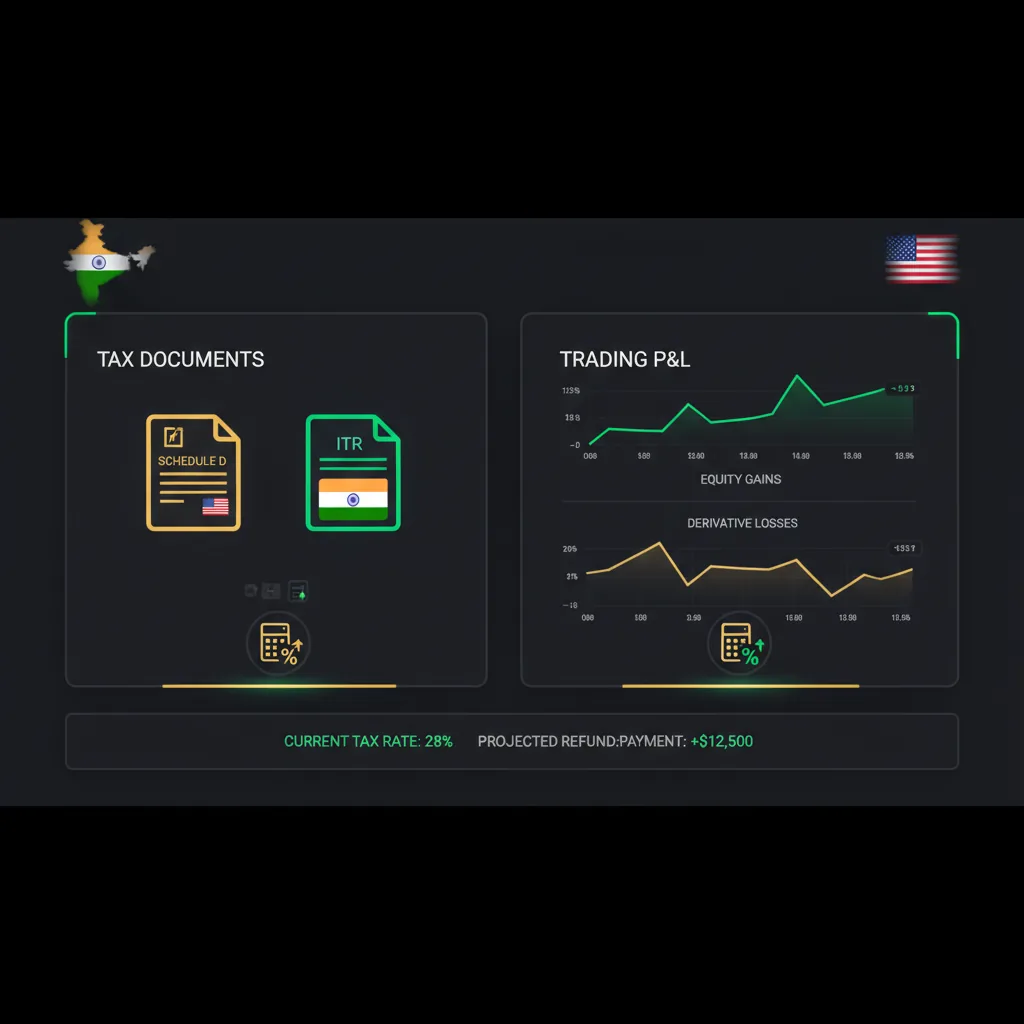
The core question: business income or capital gains?
The single most consequential tax question for an algo trader: are your trading profits classified as business income or capital gains? The answer determines:
The classification rules differ sharply between India and the US — both in the criteria used and the practical effect on your bot's net income.
US tax framework for trading bots
The IRS classifies traders into three categories with very different tax treatments.
Investor (default classification)
If you don't qualify as a trader-in-securities, your trading is treated as investing. Profits are capital gains. Holdings under one year are short-term capital gains taxed at ordinary income rates (up to 37% federal). Holdings over one year are long-term capital gains (0%, 15%, or 20% based on income).
Most automated retail bot operators fall here by default. The IRS bar for "trader-in-securities" status is high.
Trader-in-securities (TTS)
Eligible if you trade frequently (typically 4+ trades a day on most market days), with substantial volume, primarily for short-term gains. TTS-eligible traders can:
The Mark-to-Market election is powerful for active traders — losses become fully deductible against ordinary income with no $3,000 cap. The trade-off: gains are taxed at ordinary income rates, not the preferential capital-gains rate.
Section 1256 contracts
A separate framework that applies to certain instruments — regulated futures, broad-based index options, foreign currency contracts. Gains and losses are taxed at the "60/40 rule": 60% long-term capital gains, 40% short-term capital gains, regardless of actual holding period.
For forex bots trading EURUSD, GBPUSD, etc., the position depends on how the trade is structured. Spot forex on margin can be elected under Section 988 (ordinary income/loss) or Section 1256 (60/40 split) by default for some instruments. The choice has material tax impact.
Consult a tax professional before assuming any specific treatment — the rules have evolved and broker reporting practices vary.
Indian tax framework for trading bots
India treats trading income very differently from the US, and the rules are more punishing for active traders.
Speculative business income vs non-speculative business income
The Income Tax Act distinguishes two categories of trading income:
This matters enormously for algo bots. An intraday equity bot generates speculative business income. A futures bot generates non-speculative business income. The latter is significantly more tax-efficient because losses are more usefully offsettable.
Currency F&O trading
Forex spot trading is restricted for Indian retail traders. The legal route for FX exposure is through SEBI-regulated currency derivatives (USDINR, EURINR, GBPINR, JPYINR) traded on Indian exchanges. These are F&O, taxed as non-speculative business income.
For an Indian retail trader running a bot, currency F&O on Indian exchanges is the tax-efficient structure. Direct spot FX trading via offshore brokers operates in a gray legal area and creates its own tax complexity.
Foreign asset reporting
Indian residents holding accounts at foreign brokers (for trading offshore instruments) must report those accounts annually under Schedule FA of the ITR. Failure to report carries severe penalties — including up to ₹10 lakh per year of non-disclosure regardless of the account size.
If your bot trades through a non-Indian broker, this reporting requirement is mandatory. Many retail algo traders are unaware of this.
Tax audit threshold
Indian traders with business income (which includes most algo trading) over specified thresholds — currently ₹1 crore turnover for businesses, ₹50 lakh for professionals, with lower limits for businesses with high non-cash transactions — must have books audited under Section 44AB. For futures and options traders, turnover is calculated as the absolute sum of profits and losses (not net), which can push the threshold faster than expected.
A bot taking 500 trades a year on USDINR futures can hit ₹1 crore turnover even with modest net P&L. The audit requirement adds compliance cost.
What about TDS on trading?
In India, intraday and F&O profits are not subject to TDS at the broker level (no source-of-payment withholding). The trader is responsible for advance tax payments quarterly if total tax liability exceeds ₹10,000 in a year.
Missing advance tax deadlines triggers interest under Sections 234B and 234C. For a profitable bot, advance tax planning is mandatory — not optional.
What expenses can I deduct for a trading bot?
In the US, if you qualify as a Trader-in-Securities, you can deduct:
In India, if treated as business income (which most algo trading is), similar expenses are deductible against trading income. Key categories:
The discipline: keep clean records year-round. Don't reconstruct expenses at filing time.
How do I report PineForge bot trades?
Direct answer: PineForge generates per-trade transaction logs via the platform's billing and trade history. Export these into your tax software or share with your accountant.
For US filers:
For Indian filers:
The trade-by-trade detail is needed regardless of jurisdiction. The platform's billing dashboard exports CSV-format transaction history that maps directly to most tax software inputs.
Tax-efficient structures for active algo traders
Three structures worth considering for serious bot traders:
LLC or sole proprietorship (US)
Routing trading through an LLC doesn't change the tax treatment for a single-member LLC (still passes through to your personal return) but creates a cleaner accounting separation and can simplify the case for Trader-in-Securities status.
Section 1256 instruments where applicable (US)
If your strategy can be implemented in regulated futures or eligible options, the 60/40 tax treatment is materially better than ordinary income rates for high-income traders. The strategy logic might be the same; the tax efficiency is very different.
Currency F&O on Indian exchanges (India)
Compared to offshore spot FX, Indian currency futures and options offer cleaner tax treatment (non-speculative business income, full loss offset against business income), no foreign-asset reporting requirement, and SEBI-regulated structure.
The bot needs to be configured for the available instruments. Strategies that work on EURUSD spot don't always translate directly to USDINR futures, but many do with parameter adjustment.
How does a trading bot affect my regular taxes?
If your bot is profitable, it adds income that increases your marginal tax bracket — potentially shifting your other income (salary, dividends, capital gains) into higher brackets.
If your bot is unprofitable, the loss treatment depends on classification. Speculative losses in India can only offset speculative profits — they don't reduce your salary tax. Non-speculative business losses can offset most non-salary income but carry forward limitations apply.
This is why active traders consult professionals annually — not just at filing time, but mid-year when strategy and structure choices can still be optimised.
Common tax mistakes for bot traders
Five that show up repeatedly:
Conclusion
Trading bot income is income. The classification — capital gains, business income, speculative income, Section 1256 — determines the tax rate and the loss-offset rules. The difference between optimal and default treatment can be 15–25% of your annual P&L.
Three rules:
Build the strategy, deploy the bot, monitor the P&L — and don't forget that the tax structure around the bot determines what fraction of profits you actually keep. Run your bot on PineForge and use the platform's transaction exports for clean year-end reporting.
*Disclaimer: This article provides general information only. Tax laws change and individual situations vary. Consult a qualified tax professional or chartered accountant before making tax decisions based on this content.*
Start Trading Smarter
Build, backtest, and deploy your strategies with PineForge. No coding experience required.