Best Crypto Trading Bots for Automated Strategies in 2026
PineForge Team
Automated Trading Platform
Crypto trading bot categories work differently from forex bot categories. Markets run 24/7, execution can be exchange-native or external, and the dominant strategy types (grid, DCA, trend) have different cost and risk profiles than forex equivalents. Most "best crypto trading bot 2026" listicles compare apples to oranges.
This guide separates the categories by what they actually do, the cost structure that matters for retail crypto traders, and which fits which strategy type.

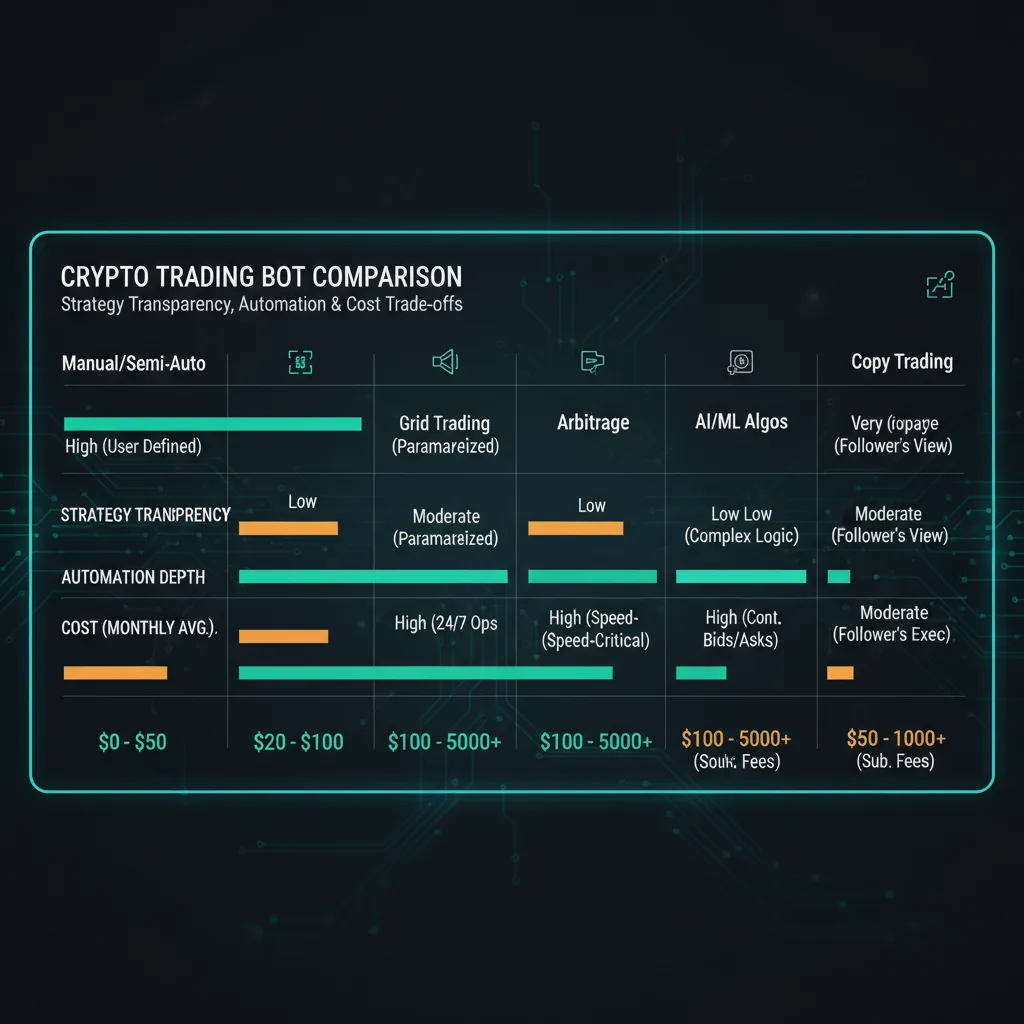
Quick comparison: crypto trading bot categories
How Crypto Bot Ranking Differs From Forex
The criteria that matter for crypto automation:
The strongest crypto bots in 2026 aren't necessarily the ones with the most "AI" branding. They're the ones with clear strategy logic, trade-only API permissions, and realistic backtests.
1. Pine Script Crypto Strategy Platforms
Platforms like PineForge support BTCUSD, ETHUSD, and major altcoins for both backtesting and live trading. Write or use a Pine Script strategy, validate it on years of crypto OHLC data with realistic execution modeling, then deploy.
The advantage versus exchange-native bots: full strategy ownership and transparency. The advantage versus generic multi-asset platforms: Pine Script is the de facto retail strategy language, with thousands of validated community strategies available.
Best for strategy-focused crypto traders who want to design or modify the trading logic.
2. Exchange-Native Grid Bots
Built directly into major exchanges. Place automated buy/sell orders across a price grid to capture profits from sideways movement. Strong in ranging markets; weak when prices trend.
The bot lives inside the exchange, requires no external API connection, and runs without subscription cost (the exchange profits from your spread/commission).
Best for beginner crypto investors targeting range-bound altcoins, low-time-commitment automation, and traders who don't want to learn strategy design.
3. Multi-Exchange Aggregators
Centralise position management across Binance, Coinbase, OKX, Bybit and others from one dashboard. Useful for traders with positions across exchanges or those running multiple strategies in parallel.
Best for diversified crypto portfolios, experienced automation users, traders managing accounts across multiple venues.
4. No-Code Rule Builders
Visual interface for creating "if X then Y" rules without programming. Bridges manual trading and full Pine Script-style logic.
Best for beginners learning automation, no-code users testing concepts, traders prototyping simple rule-based strategies before committing to a coded approach.
5. DCA Automation
Dollar-cost-averaging bots that buy fixed amounts on a schedule. Simplest crypto automation; specifically suited to long-term accumulation rather than active trading.
Best for long-term crypto investors, traders separating accumulation from active strategy, accounts where the goal is exposure not alpha.
6. Quantitative Crypto Platforms
Fully automated, multi-strategy crypto trading run by the platform on user capital. Sometimes opaque about the actual strategies being executed. Cost typically a profit share.
Best for hands-off investors who don't want to design strategies. Verify the platform's strategy disclosure carefully before committing capital.
What Crypto Pairs Work Best for Bots?
BTCUSD and ETHUSD are the strongest starting points. Highest liquidity, tightest spreads, deepest historical data for backtesting.
Major altcoins (SOL, BNB, XRP, ADA, AVAX) work for grid and trend strategies but have higher per-trade costs and noisier price action.
Memecoins and low-cap altcoins are inappropriate for most automation — spread, slippage, and liquidity make backtested edges disappear in live trading.
For strategy-specific guidance, see our piece on forex vs crypto trading.
Are Crypto Trading Bots Profitable?
Same answer as forex: sometimes. Profitability depends on strategy quality, sizing discipline, and market regime more than on bot platform.
Grid bots are profitable in ranging markets and unprofitable in strong trends. Trend bots are the inverse. The trader who runs both simultaneously — as part of an ensemble portfolio — captures both regimes.
Quantitative platforms (#6 above) can be profitable but are the highest-risk category because you're delegating strategy design to a third party. Verify track records and strategy disclosure before committing capital.
What's the Best Crypto Trading Bot for Beginners?
The most beginner-appropriate categories are DCA automation (lowest risk, simplest model) and exchange-native grid bots (built-in, no external connection, predictable behaviour in ranging markets).
For beginners ready to learn strategy design, Pine Script platforms offer the best learning curve — you can use community strategies first, then modify them as understanding grows.
Avoid: anything marketed as "AI-powered passive income" with opaque strategy disclosure. The marketing isn't the warning sign; the lack of strategy transparency is.
Do Crypto Bots Require Constant Monitoring?
Less than manual trading, but they're not "set and forget." Strategy decay, exchange outages, and regime shifts all require periodic review. The strategy decay detection guide covers the monitoring framework.
A reasonable cadence: weekly equity curve check, monthly performance review, quarterly strategy evaluation. Less than that and you'll miss decay signals; more than that and you'll over-react to normal variance.
What About Wallet Security When Running Crypto Bots?
Critical: never give a trading bot withdraw permission on your exchange account. Standard trading API permissions (place orders, view balance, cancel orders) are sufficient for any legitimate bot. Withdraw permission isn't needed for trading and creates catastrophic risk if the bot's credentials leak.
Most reputable platforms use trade-only API keys by default. If a platform asks for withdraw access, treat that as a red flag.
Conclusion
The "best crypto trading bot in 2026" depends on your goal. Long-term accumulators want DCA. Range traders want grid bots. Strategy designers want Pine Script platforms. Hands-off investors want quantitative platforms (with strategy-transparency verification).
For most retail crypto traders who want to own the strategy logic and see every trade, Pine Script automation platforms are the strongest category. PineForge supports BTCUSD and ETHUSD natively with realistic execution modeling — start there if strategy ownership matters to you.
For traders who explicitly want to delegate the strategy, the quantitative-platform category is viable but requires diligence on strategy disclosure. Don't skip that step.
| Category | Best For | Risk Profile | Cost Structure |
|---|---|---|---|
| Pine Script crypto strategies | Strategy traders | Strategy-dependent | Pay-per-use |
| Exchange-native grid bots | Range-bound trading | Mild–moderate | Free (in spread) |
| Multi-exchange aggregators | Diversified portfolios | Moderate | Subscription |
| No-code rule builders | Beginners | Mild | Subscription |
| DCA automation | Long-term accumulation | Mild | Often free |
| Quantitative crypto platforms | Hands-off investors | Variable, opaque | Profit share |
Start Trading Smarter
Build, backtest, and deploy your strategies with PineForge. No coding experience required.