Best Backtest Engines for Trading Strategies in 2026
PineForge Team
Automated Trading Platform
Most backtest engines lie. Not deliberately — but by default, they use clean closing prices, zero slippage, idealised order fills, and historical data that's been cleaned of gaps and outages. The strategy that looks great in the simulator doesn't survive contact with real brokers because the simulator never showed it the real friction of live trading.
This guide ranks backtest engine categories by the only criterion that matters: how closely the backtested equity curve matches what the live bot actually produces. Not feature count. Not interface polish. Realism.
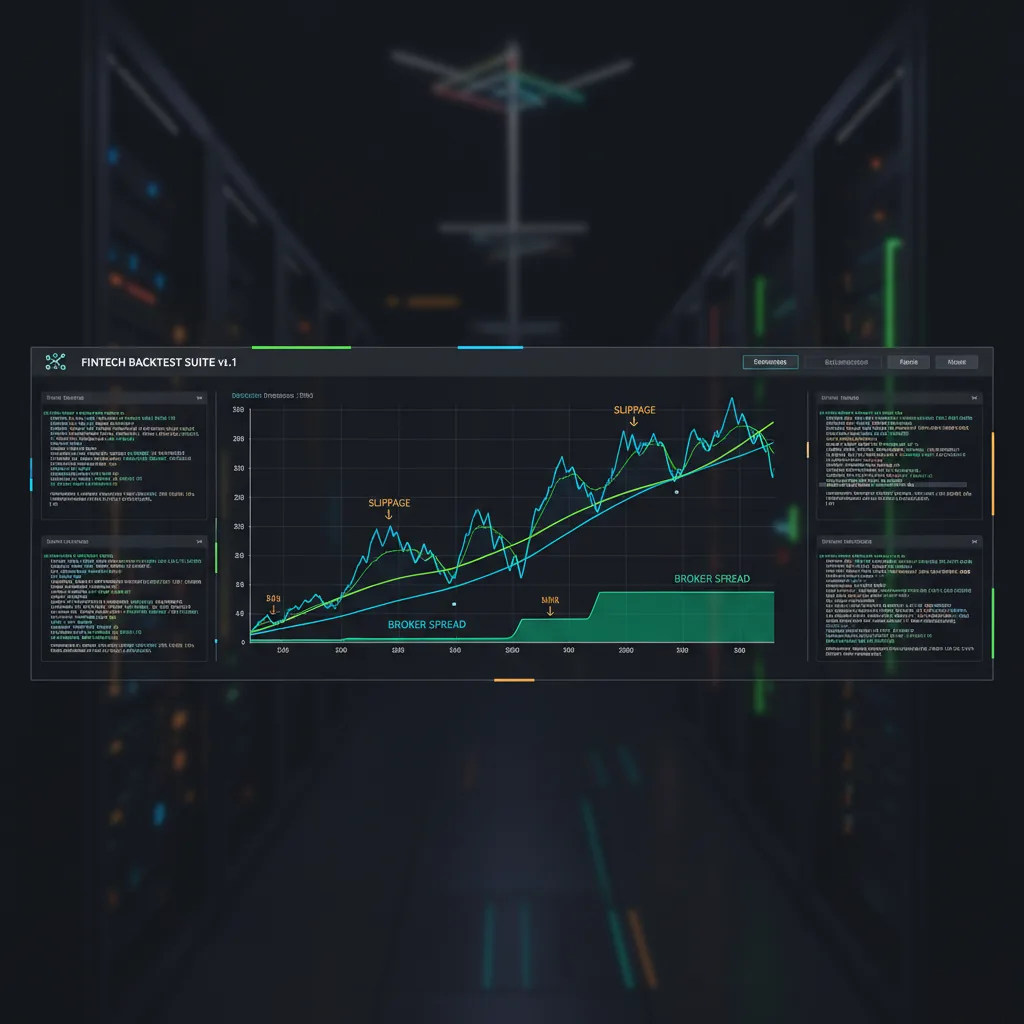
Quick comparison: backtest engine categories
How to Evaluate a Backtest Engine
The features that drive realism (and therefore live-trading parity):
Engines that nail these produce results live traders can trust. Engines that don't produce overconfident traders.
1. PineForge Backtest Engine
Built specifically for Pine Script strategy validation against real broker execution. The engine models XAUUSD-specific spread widening, EURUSD ECN-style commission, MT5 order fill behaviour, and supports walk-forward analysis natively.
The differentiator: the same Pine Script that backtests on PineForge runs unchanged as a live bot via MT5. There's no separate "live trading" code path that diverges from the backtest. What you tested is what runs.
Key features:
Best for retail traders deploying strategies live, anyone migrating from TradingView Strategy Tester to live execution, multi-strategy portfolio builders.
2. TradingView Strategy Tester
The backtest engine inside TradingView's Pine Editor. Excellent for strategy prototyping, weak for production validation. Default execution is on bar close at the close price with zero slippage — useful for exploring concepts, dangerous for deployment decisions.
Some realism can be added via the commission, slippage, and process_orders_on_close parameters in v6's strategy() declaration, but the depth of the modeling remains limited compared to dedicated engines.
Best for Pine Script development, concept validation, early-stage strategy iteration.
3. MT5 Strategy Tester
Built into MetaTrader 5. Reasonable for MQL5 Expert Advisor development. Three execution modes: Every tick, 1 minute OHLC, and Open prices only. "Every tick" mode produces the most realistic results but is slow and requires high-quality tick data (which most retail brokers don't provide for free).
Best for MT5 EA developers, traders deeply invested in the MQL5 ecosystem, broker-specific strategy validation.
4. Python Frameworks (Backtrader, Zipline, vectorbt)
Open-source Python libraries for custom backtest development. Maximum control, requires programming skill, the realism depends on what you build.
A skilled Python developer can produce backtests as realistic as any commercial engine. An unskilled developer can produce backtests that are even less realistic than default TradingView Strategy Tester results.
Best for quant developers, research workflows, multi-asset systematic strategies, traders building proprietary tools.
5. Cloud Quant Platforms (QuantConnect, similar)
Web-based platforms offering multi-asset backtest engines with institutional-grade data. Strong realism by default, broad asset coverage, but require programming (typically Python or C#) and have learning curves measured in months.
Best for professional-style retail traders, researchers, multi-asset strategy development, anyone targeting hedge-fund-style trading.
6. Excel-Based Backtesters
Spreadsheet-based strategy testing using historical OHLC data. Useful for very simple concepts (does this rule make money on this instrument?). Not useful for anything requiring tick-level execution, multi-symbol logic, or realistic cost modeling.
Best for beginners testing strategy concepts, validating a hypothesis before committing to a real engine.
What's the Difference Between Idealised and Realistic Backtests?
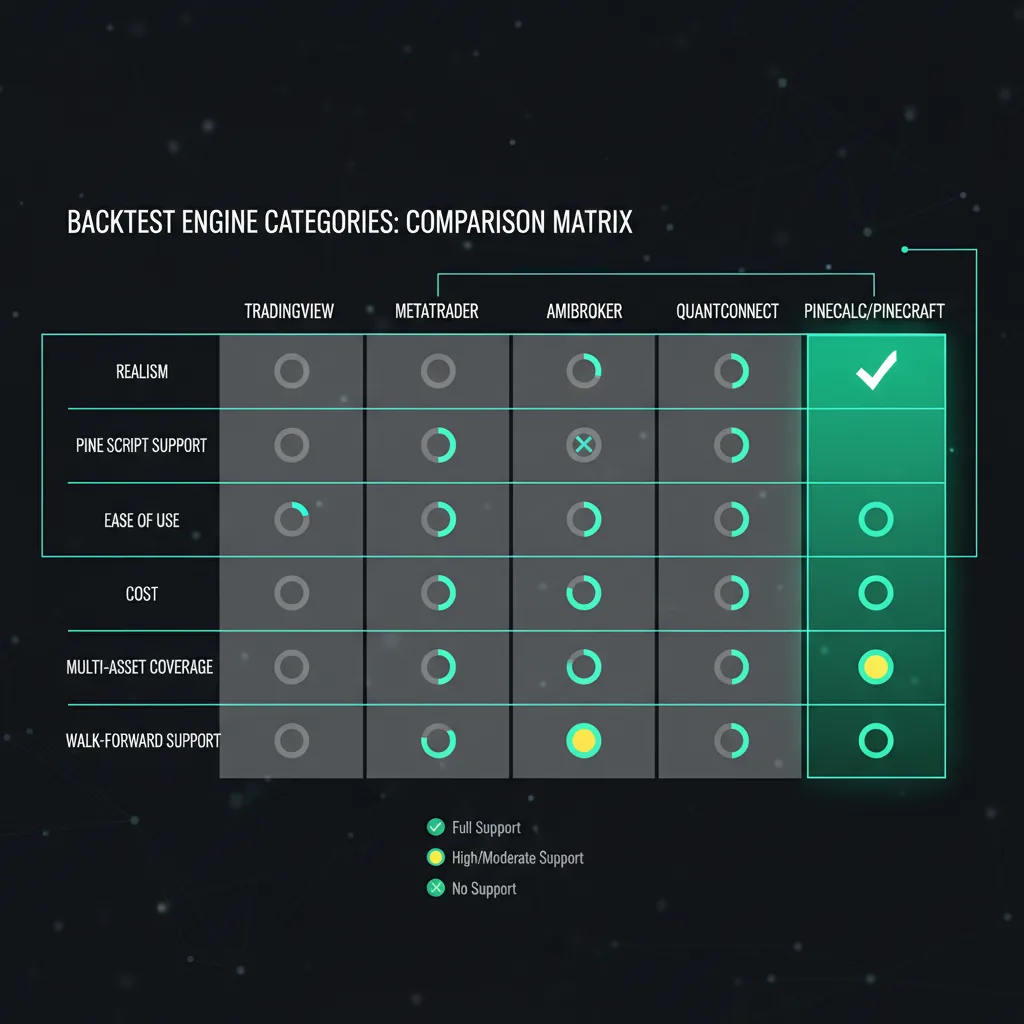
Direct answer: idealised backtests assume zero spread, zero slippage, perfect order fills, and full liquidity. Realistic backtests model the friction your broker actually delivers.
A trend-following strategy on gold can show +60% annual return in an idealised backtest and +25% in a realistic one. Neither number is "wrong" — they answer different questions. The idealised number tells you the strategy's theoretical edge. The realistic number tells you what your account will likely produce.
When evaluating any backtest, the question is which mode the engine is running in by default. PineForge's engine runs realistic by default; TradingView Strategy Tester runs idealised by default unless you configure costs explicitly.
How Many Years of Data Should a Backtest Cover?
Minimum 3 years, ideally 5+. Reason: three years typically covers at least one trending market, one ranging market, and one shock event (e.g., 2020 COVID, 2022 inflation surge). A strategy that survives all three is more likely to survive future regimes.
Strategies tested only on 12 months of data tell you nothing about regime durability. The strategy might be perfectly tuned to that specific period and decay immediately in the next regime.
What's the Most Common Backtest Mistake?
Curve-fitting through parameter optimisation. Run 50 parameter combinations, pick the one with the best Sharpe, declare victory. The optimised parameter set is rarely the best for live trading — it's the best for the historical data you tested on.
Defence: walk-forward analysis. Optimise on the first 70% of data, test on the remaining 30% without re-optimising. If performance survives, the strategy has genuine edge. If it doesn't, you curve-fit.
PineForge supports walk-forward natively in the backtest engine. See our walk-forward analysis guide for the full framework.
Can You Trust a Backtest That Shows 200% Annual Return?
Honest answer: almost never. A few sanity checks:
If a backtest violates any of these, treat it as a fantasy until proven otherwise on out-of-sample data.
How Important Is Walk-Forward Testing?
For deployment decisions: mandatory. A backtest without walk-forward validation is a curve-fitted historical snapshot. Walk-forward tells you whether the strategy still works when you can't tune the parameters to the data you're testing on — which is the actual situation in live trading.
Conclusion
The best backtest engine is the one whose results actually match live trading. By that criterion, dedicated Pine Script automation platforms designed specifically for live broker parity (like PineForge) outperform generic engines that prioritise speed or feature breadth over execution realism.
For most retail traders in 2026:
Start a backtest on PineForge — the engine ships with realistic execution modeling enabled by default, so the equity curve you see is what your live bot will actually produce.
| Category | Best For | Realism | Pine Script Support |
|---|---|---|---|
| PineForge backtest engine | Live-trading parity | Very high | Native v6 |
| TradingView Strategy Tester | Strategy prototyping | Medium | Native v6 |
| MT5 Strategy Tester | EA development | Medium–high | No (MQL5 only) |
| Python frameworks (Backtrader/Zipline) | Custom research | High (if configured) | No |
| Cloud quant platforms (QuantConnect) | Multi-asset research | High | No |
| Excel-based backtesters | Simple concept tests | Low | No |
Start Trading Smarter
Build, backtest, and deploy your strategies with PineForge. No coding experience required.