Backtesting Trading Strategies: The Complete 2026 Guide
PineForge Team
Automated Trading Platform
Every profitable trader has one thing in common: they test before they trade.
Backtesting is the process of running your trading strategy against historical market data to see how it would have performed. It's the difference between gambling and trading — between hoping your strategy works and knowing it works.
Yet most retail traders skip this step entirely. They see a YouTube video about RSI, open a live account, and start clicking. The result? Blown accounts and broken confidence.
Here's how to do it right.
What Does a Backtest Actually Tell You?
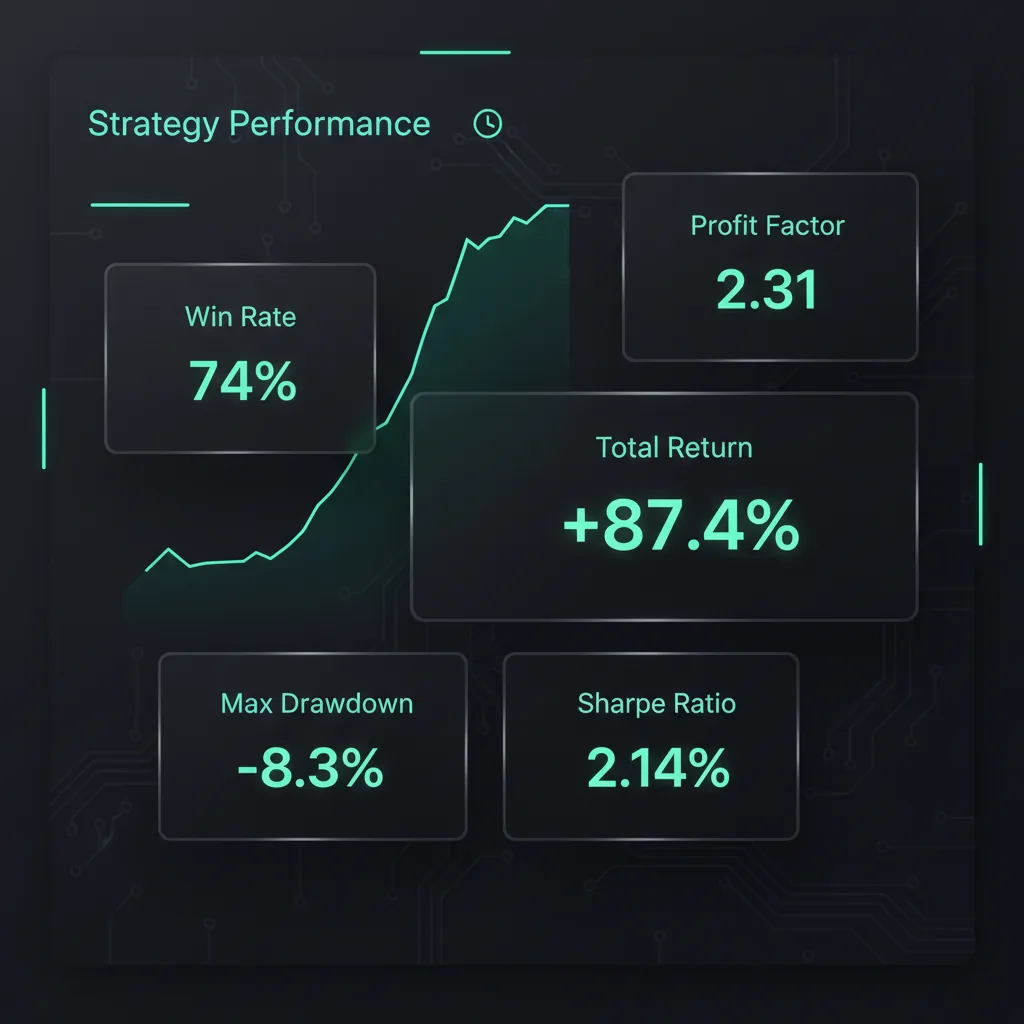
A proper backtest reveals five critical numbers about your strategy:
Total Return
The bottom line. If you started with $10,000, how much would you have at the end? On PineForge, one XAUUSD strategy showed a +87.4% return over 156 trades — turning $10,000 into $18,740.
Win Rate
What percentage of your trades are profitable? Anything above 50% is decent. Above 65% is strong. But win rate alone means nothing without the next metric.
Profit Factor
The ratio of total profits to total losses. A profit factor of 2.0 means you make $2 for every $1 you lose. Most successful strategies land between 1.5 and 3.0. Below 1.0 means you're losing money.
Maximum Drawdown
The worst peak-to-trough decline during the backtest period. This tells you the pain you'll endure. A strategy with +80% return but -40% max drawdown might give you a heart attack before the profits arrive.
Sharpe Ratio
Risk-adjusted return. Higher is better. Above 1.0 is acceptable. Above 2.0 is excellent. This tells you whether your returns are worth the risk you're taking.
How Does Backtesting Work on PineForge?
The process is straightforward:
Our engine uses next-bar-open execution to simulate realistic fills and includes 200 warmup bars for indicator stability. No look-ahead bias. No inflated results.

What Are the Biggest Backtesting Mistakes?
Even experienced traders fall into these traps.
Overfitting: The Silent Account Killer
Your strategy has 15 parameters, each optimized to perfection on 6 months of data. Win rate: 89%. Profit factor: 5.2. Looks incredible.
Then you run it live and it loses money immediately.
This is overfitting — building a strategy that memorizes past data instead of learning from it. The fix: use simple strategies with few parameters, and test on out-of-sample data (dates your strategy hasn't seen).
Ignoring Transaction Costs
A strategy that returns 3% per month before costs might return 0.5% after spreads, slippage, and commissions. PineForge accounts for these costs in backtesting so your results match reality.
Survivorship Bias
Only testing on assets that exist today ignores the ones that went to zero. This matters more for stocks than forex, but it's worth knowing.
Not Enough Trades
A backtest with 12 trades proves nothing — it could be pure luck. Aim for at least 50 trades, ideally 100+. Statistical significance requires sample size.
What Makes a Good Backtest Result?
Here's a benchmark framework:
A PineForge user tested a Bollinger Band reversion strategy on EURUSD and achieved a profit factor of 2.67 with +208% return over 412 trades across 3 years. That's the kind of statistical confidence you need before risking real capital.
From Backtest to Live Trading Bot
The best part about backtesting on PineForge? When you find a winning strategy, you deploy it as a live trading bot with one click. Same code, same parameters — but now executing on your real MT5 account.
No re-coding. No translation. The strategy runs identically live as it does in backtesting.
Backtest your first strategy on PineForge — free to get started, no credit card required.
| Metric | Poor | Acceptable | Strong |
|---|---|---|---|
| Win Rate | < 40% | 40-55% | > 55% |
| Profit Factor | < 1.2 | 1.2-2.0 | > 2.0 |
| Max Drawdown | > -30% | -15% to -30% | < -15% |
| Sharpe Ratio | < 0.5 | 0.5-1.5 | > 1.5 |
| Total Trades | < 30 | 30-100 | > 100 |
Start Trading Smarter
Build, backtest, and deploy your strategies with PineForge. No coding experience required.