Best Trading Bots for Beginners in 2026
PineForge Team
Automated Trading Platform
"Best trading bot for beginners" articles usually recommend the platforms with the slickest mobile apps. That's wrong. Beginner-friendly bots aren't the ones with the most polished UX — they're the ones with the clearest path from "I want to learn this" to "I have a working strategy I understand."
A beginner who deploys a black-box bot they don't understand learns nothing. A beginner who builds, breaks, and fixes a simple strategy on a transparent platform learns everything. The platform that supports the second path is the better beginner bot, even if its UX is uglier.
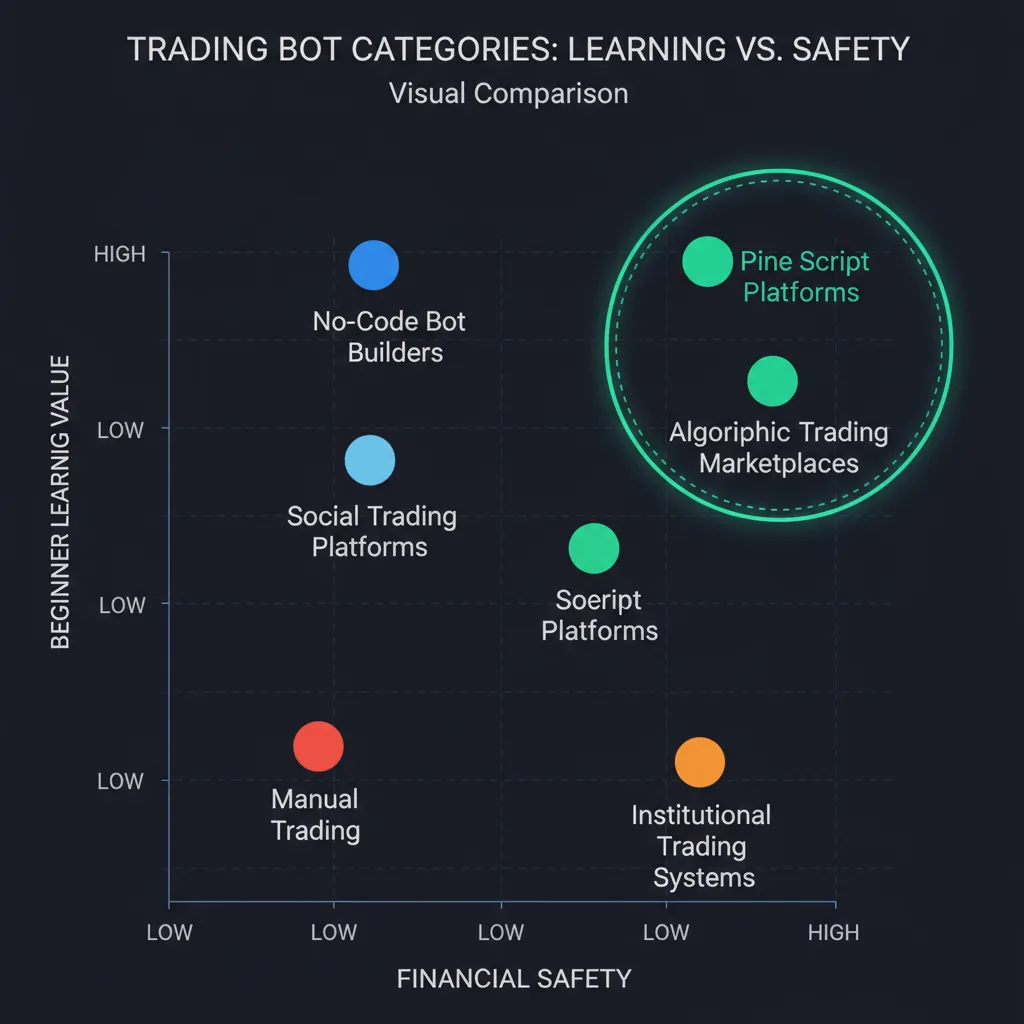
This guide ranks beginner trading bot categories by learning quality and financial safety, not by interface polish.
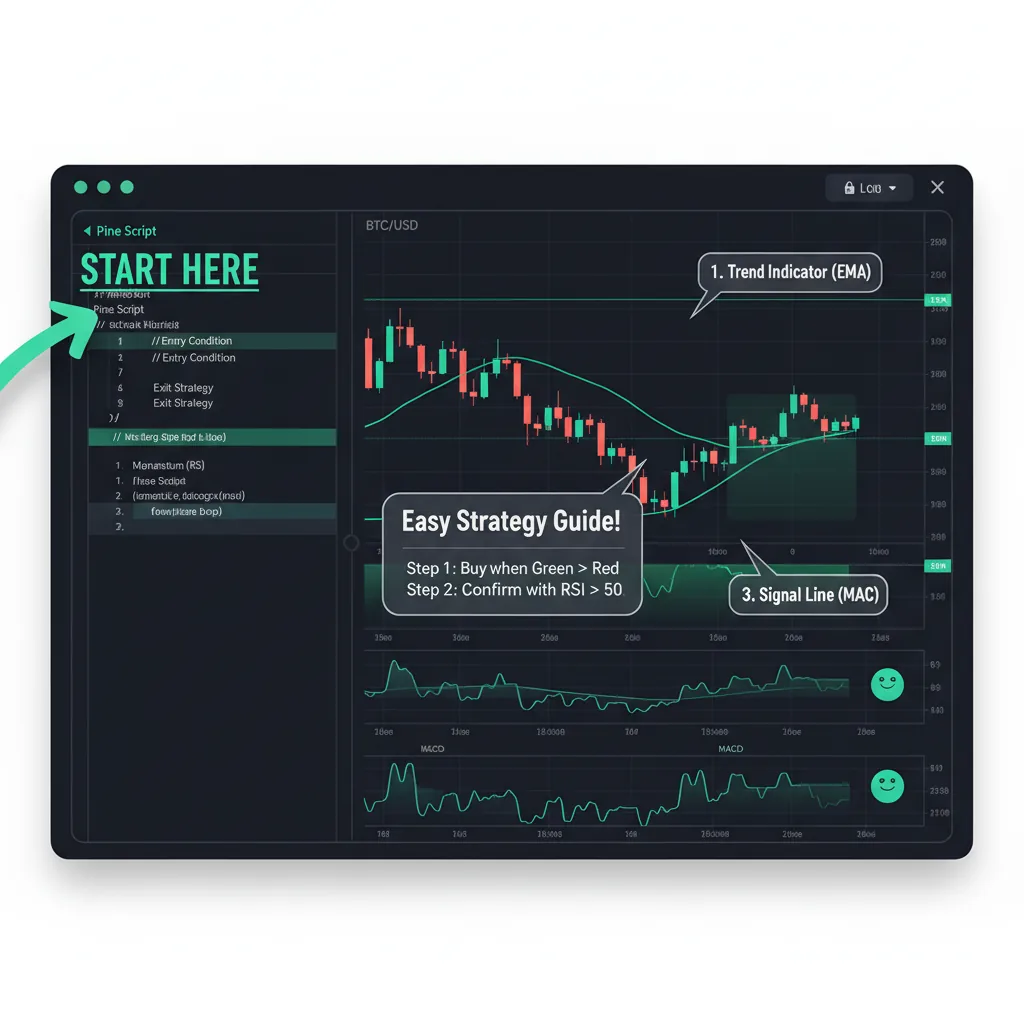
Quick comparison: beginner trading bot categories
What Actually Matters for Beginner Bots
The features that drive long-term success for beginners:
Beginner bots that score well on these criteria produce traders who keep growing. Bots that score poorly produce traders who blow up small accounts and quit.
1. Pine Script Platforms with Community Strategies
Pine Script platforms like PineForge support beginner traders through three layers:
The platform isn't trying to hide the strategy from you. It's giving you a working strategy that you can use as-is or modify as understanding grows.
Key features for beginners:
Best for beginners committed to learning, traders who want to grow into custom strategies, anyone tired of opaque black-box "AI" platforms.
2. No-Code Rule Builders
Visual "if X then Y" interfaces let beginners create automation without programming. Strong learning tools because the rules are explicit — you see exactly what triggers each trade.
Best for absolute beginners testing automation concepts, no-code users, traders prototyping simple rule-based strategies.
3. Exchange-Native Grid Bots
Built into crypto exchanges. Place automated grid orders to profit from range-bound movement. The rules are transparent (grid spacing, price range) and the bot lives inside the exchange you're already using.
Best for crypto beginners, range-bound altcoin trading, users who want minimal setup.
4. DCA Automation
Dollar-cost-averaging bots that buy a fixed amount on a schedule. Simplest possible automation. The "strategy" is just calendar-based buying.
Best for long-term crypto accumulators, beginners separating accumulation from active trading. Limited learning value because there's only one concept.
5. Copy-Trading Services
Mirror trades from another trader's account. Lowest setup, highest delegation. Beginners learn nothing because they don't see the logic — they just see the P&L.
Best for beginners who explicitly do not want to learn trading. Limited as a long-term growth path because you never develop your own skill.
6. Quantitative "AI" Platforms
Fully automated platforms running proprietary strategies on user capital. Opaque about what's actually being traded. High delegation, low transparency.
Beginner caution: these platforms are often heavily marketed to beginners specifically because they require no skill. The trade-off is no learning and no control. Verify strategy disclosure carefully if considering this category.
How Much Money Should a Beginner Start With?
Demo first, real money second. Most reputable platforms support demo mode. Run a strategy on demo for at least 4–8 weeks before risking real capital.
When you move to real money: $500–$1,000 is the practical minimum for realistic forex or gold automation. Smaller accounts run into broker minimum lot sizes and fixed platform costs that consume too much of expected returns.
For crypto: $100–$500 can be viable for grid or DCA bots given the smaller per-trade costs.
See our position sizing guide for the math on what account sizes actually work for which strategy types.
What's the Easiest Trading Bot to Set Up?
Direct answer: exchange-native grid bots for crypto, or community Pine Script strategies for forex/gold. Both let you go from zero to a running automated strategy in under 30 minutes.
PineForge's onboarding specifically supports the second path — new users land on the dashboard and are guided to a pre-configured backtest of Gold Trend Hunter V2 on XAUUSD 1H with the trailing 12 months of data. One click and you see how a real strategy would have performed. Modify from there as you learn.
Should Beginners Use AI Trading Bots?
Be careful with the term. "AI trading bot" can mean anything from a rule-based bot with one ML-driven parameter (legitimate, useful) to a fully delegated black-box system (problematic for beginners).
See our how AI trading bots actually work piece for the framework. For beginners specifically: prefer rule-based bots with optional ML features over fully delegated AI platforms. The learning curve is meaningful.
What's the Biggest Mistake Beginners Make With Trading Bots?
Trusting backtest results too literally. A backtested 80% win rate looks great. The same strategy live often produces 60–65% — and that's normal, not a failure. The backtest didn't see slippage, news days, or your specific broker's execution behaviour.
The defence: realistic backtests with proper cost modeling (see hidden trading bot costs) and walk-forward validation before deployment.
How Long Before a Beginner Sees Results?
Honest answer: 6–12 months to develop reliable judgment. The first 3 months is learning what the platform does and what your strategy actually behaves like in live trading. Months 4–6 you start recognising regime changes and strategy decay patterns. Months 7–12 you've built enough live trading experience to make confident decisions about scaling capital or modifying strategy.
Anyone marketing "instant results" to beginners is selling, not teaching.
Conclusion
The best trading bot for beginners in 2026 is the one that maximises learning while minimising financial risk during the learning phase. By those criteria:
Avoid: heavily marketed "AI passive income" platforms with opaque strategy disclosure. The marketing isn't the warning sign; the lack of transparency is.
Start with a pre-built strategy you can read, backtest it on PineForge with realistic costs, deploy on a small account once the math justifies it. The trader who follows this path builds real skill. The trader who skips to "AI passive income" usually pays the platform's marketing budget with their account.
| Category | Learning Quality | Min Account | Strategy Transparency |
|---|---|---|---|
| Pine Script platforms with community strategies | High | $500+ | Full |
| No-code rule builders | High | $200+ | Full |
| Exchange-native grid bots | Medium | $100+ | Full |
| DCA automation | Low (one concept) | $100+ | Full |
| Copy-trading services | Very low | $500+ | None |
| Quantitative platforms | Very low | Often $1,000+ | None |
Start Trading Smarter
Build, backtest, and deploy your strategies with PineForge. No coding experience required.