How Many Trading Bots Should You Run Per MT5 Account? (Hint: One)
PineForge Team
Automated Trading Platform
"Why can't I run three bots on the same MT5 account? They use different magic numbers — they shouldn't conflict."
This is one of the most common questions new automated traders ask. The intuitive answer is "you can." The correct answer is "you shouldn't." The difference between the two is the gap between a reliable trading operation and one that quietly breaks at 3am on a Tuesday.
This guide explains why one bot per MT5 account is the only safe deployment model, what specifically goes wrong when you stack bots, and how to scale to multiple strategies without ever sharing an account.

What "Magic Numbers" Are Supposed to Do
Every order placed on MT5 carries an integer magic number, a tag that identifies which strategy or bot opened the position. The theory is elegant: bot A uses magic 1001, bot B uses magic 2002, and each bot only manages positions tagged with its own magic. Multiple strategies on one account, peacefully coexisting.
The theory works for the strategy logic. It breaks for everything else.
Where the One-Bot-Per-Account Model Wins
Brokers Strip Magic Numbers on Closes
This is the single biggest reason. When MT5 brokers — including Exness, IC Markets, FTMO, and most ECN providers — close a position via the broker's own logic (stop-out, margin call, weekend close), the resulting deal record often has the magic number reset to zero. Your bot sees a position vanish, can't match it to its own order log, and either skips the cleanup or tries to re-open it.
We've reproduced this on Exness specifically with multiple shared-account setups. The magic-stripping happens silently. Logs show the bot opening the position with magic 1001, but the OUT deal carries magic 0. From the bot's perspective, the position never closed — it just disappeared.
PnL Aggregation Becomes Unauditable
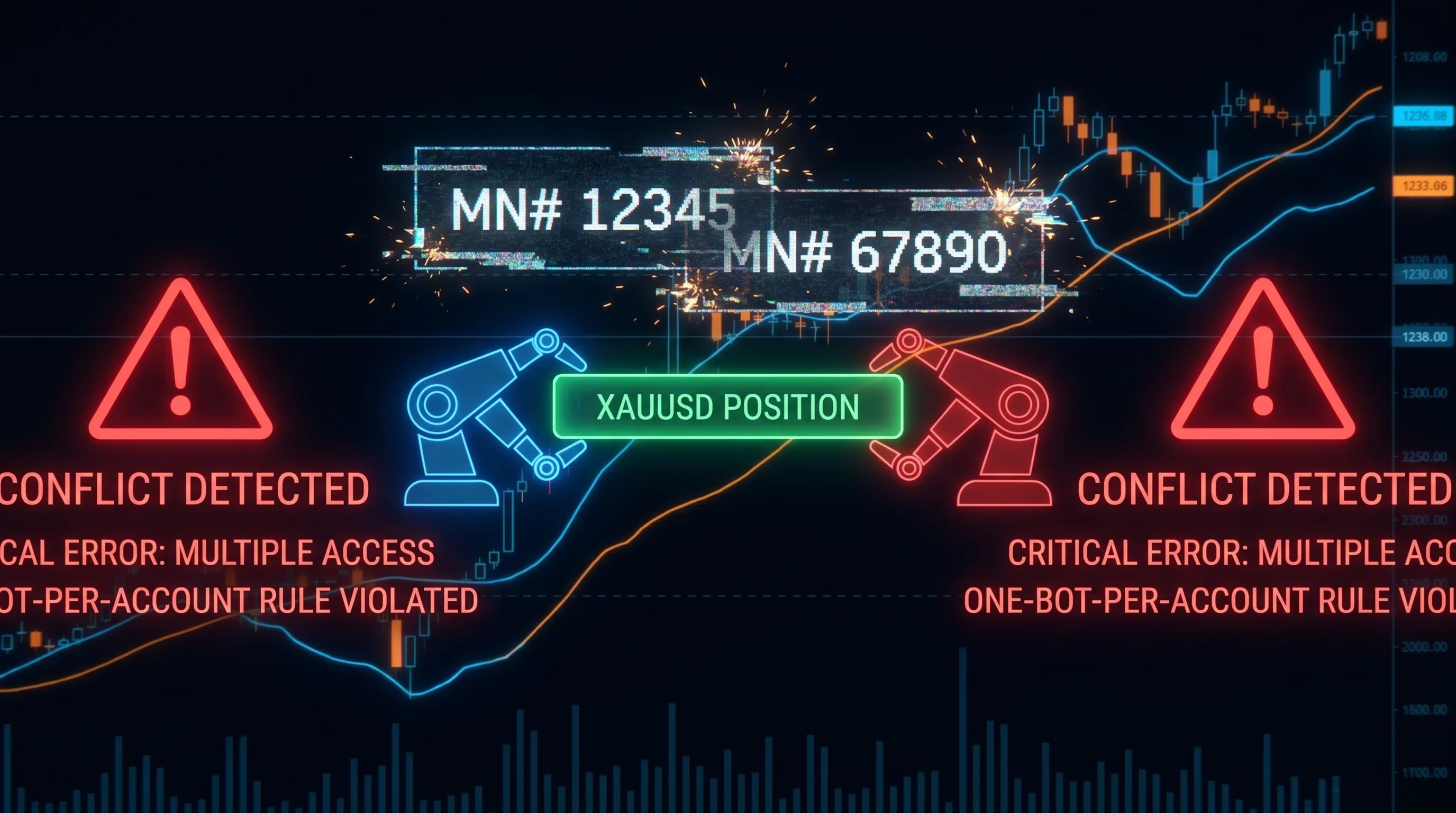
When three bots share an account and a position closes with a stripped magic, you can't attribute the PnL to any specific bot. Total account PnL is correct. Per-bot performance is fiction. You have no way to evaluate which strategy is actually working — every bot's reported PnL silently includes a slice of every other bot's losses or gains.
The consequence: you can't make rational decisions about which strategy to scale or kill. You're flying blind.
Margin Conflicts Don't Resolve Cleanly
Two bots on the same account both want to enter long XAUUSD 0.5 lots. The account has $2,000 of free margin. The first bot's order goes through. The second bot's order is rejected for insufficient margin. From each bot's perspective, the rejection looks like a broker error — neither has any awareness that another bot just consumed the available margin.
The result is silent strategy degradation. Each bot thinks it's executing its plan; in reality, both are operating on a half-functional account.
Account-Level Stops Hit One Bot's Trade Randomly
You set a 3% daily loss cap on the MT5 account. One bot trades aggressively in the morning and loses 2.8%. The second bot opens a position in the afternoon. The market moves 0.5% against it and the account-level circuit breaker fires — closing all positions. The second bot just took a loss that wasn't its fault, with no awareness that the cause was bot A's bad morning.
In an isolated account, that doesn't happen. Each bot's account stop is its own.
How to Run Multiple Strategies the Right Way
The mental shift: instead of "one account, many bots," think "one bot, one account, many accounts."

Open a Separate MT5 Account Per Strategy
Most brokers — including Exness — let you open multiple MT5 accounts under one Personal Area at no cost. Each account gets its own login, its own balance, its own margin pool. Fund each one independently based on the capital you want allocated to that strategy.
If you want to run a Gold scalper, an EURUSD trend-follower, and a BTC swing strategy, that's three MT5 accounts. Three logins, three balances, three sets of trades that never touch each other.
Connect Each Account to Its Own Bot
Inside PineForge, connect each MT5 account as a separate Trading Account record. Then create one bot per account, each with its own Pine Script strategy. PineForge enforces the one-bot-per-account model at the database level — you can't accidentally assign a second bot to an account that already has one.
This isolation is what gives you clean PnL attribution, no margin conflicts, and clean shutdowns.
Aggregate at the Dashboard, Not the Broker
Your dashboard view should aggregate across all accounts — total balance, total PnL, total open positions. Your *trading* should stay isolated per account. PineForge does this automatically. The dashboard sums everything; the execution layer keeps it apart.
Doesn't One Bot Per Account Mean More Setup Fees?
Yes — and that cost is the price of clean audit trails. Most retail-friendly brokers have minimal or no per-account fees. Exness, for example, lets you open as many MT5 accounts as you want under one verified Personal Area. The marginal cost is essentially zero.
The cost of *not* isolating, on the other hand, is one bad weekend close from a stripped magic number that wipes a position your bot can't recover from. In dollar terms over a year, the savings from sharing an account are dwarfed by even one mishandled trade.
Can I Run a Single Bot With Multiple Strategies Internally?
Yes, and this is actually the elegant answer for traders who want strategy diversification without account sprawl. Write one Pine Script that internally combines two or three signal sources — say, an EMA crossover plus an RSI filter plus a volume confirmation — and run it as a single bot on a single account.
The bot still has one identity, one magic number, and one clean PnL record. The strategy diversification happens inside the script, not across accounts. This works well when your strategies share the same symbol and timeframe. It doesn't work when you want to trade XAUUSD on 1H and BTCUSD on 4H — those genuinely need separate bots, which means separate accounts.
What If My Broker Doesn't Strip Magic Numbers?
Some brokers do preserve magic numbers on close deals. Don't bet your trading on it. The behaviour depends on the specific broker, the deal type, the closing reason, and sometimes on the broker's version of MT5 server software. Even if your broker preserves them today, an upgrade tomorrow can change that — and you won't get an announcement.
The one-bot-per-account model is broker-independent. It works the same across Exness, IC Markets, FTMO, and any other MT5 provider. Robustness beats optimisation.
Conclusion
Three takeaways. First, magic numbers are a strategy-logic feature, not an operational guarantee — brokers can and do strip them, especially on broker-initiated closes. Second, account isolation gives you clean PnL attribution, no margin conflicts, and clean per-strategy circuit breakers. Third, scaling to multiple strategies is easier with multiple accounts than it is with multi-tenant magic-number juggling.
You don't pay anything meaningful in setup costs to isolate. You pay catastrophically in audit and reliability costs to share.
Connect your Exness MT5 account to PineForge — one bot per account, magic-number isolation by design, every dollar of PnL traceable.
Start Trading Smarter
Build, backtest, and deploy your strategies with PineForge. No coding experience required.